What Can a Personalized Story Bring to a Child and Family Bonding?
 Elara Finch 7 min read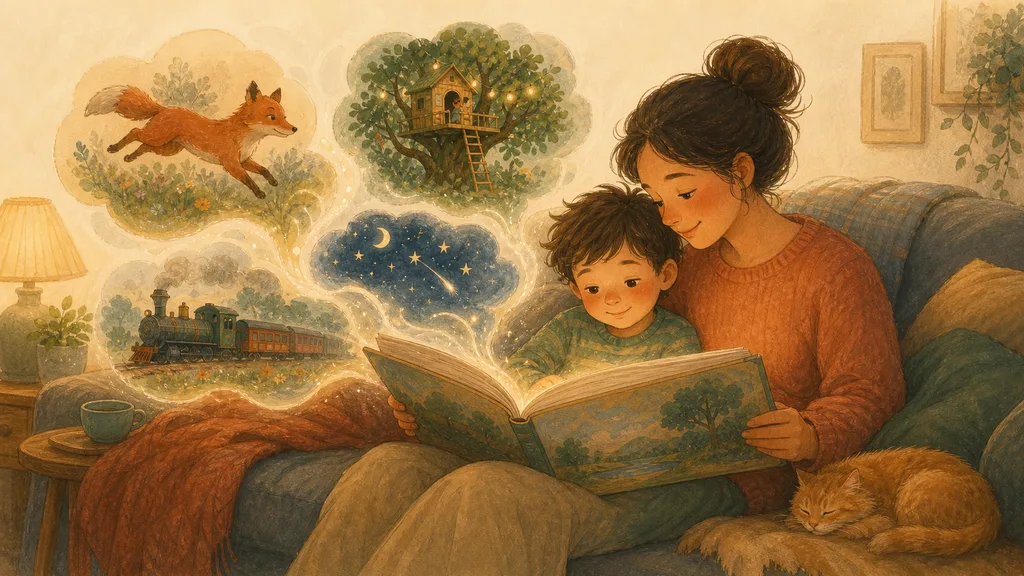
A personalized story does more than place a child inside a book. By bringing familiar interests, experiences, and emotions into shared reading, it helps children engage and gives parents a natural way to understand, respond to, and accompany them.
Its value goes beyond “I am in the story”
When parents first hear about personalized stories, they often imagine adding a child's name or making the child the hero. That can be delightful, but the novelty is only the surface.
A meaningful personalized story includes interests the child recognizes, experiences they are living through, and emotions they can understand. The child does not have to be the main character. They may instead follow a timid fox, a train leaving its station for the first time, or a little dragon learning to sleep alone.
When the character's problem connects with the child's life, the message is not merely “this story belongs to me.” It becomes “someone notices what matters to me and understands what I am going through.”
It makes reading easier to enter
Whether a child stays with a story often depends less on the correctness of its lesson than on whether the opening creates a connection.
A five-year-old fascinated by insects may not sit through an abstract lesson about courage. Begin with a ladybird afraid to leave its leaf, however, and the child may immediately ask, “Does it finally fly?” Familiar interests open the door; an unfolding plot keeps attention moving forward.
That engagement can make a child:
- more willing to listen, because familiar details create anticipation;
- better able to understand, because the character's situation connects with prior experience;
- more interested in rereading, because known details remain rewarding;
- more ready to speak, using phrases such as “I did that too” or “If it were me.”
Personalization does not mean giving children only what they already like. Interest opens the door; a good story still leads them toward new choices and a wider world.
It offers a safe rehearsal for emotions
Children cannot always explain what they feel directly. “I don't want to go to school” may mean “I am afraid I will not find my classroom.” “I don't like the baby” may hide a fear of receiving less attention.
A story creates useful distance. It is often easier to discuss a character's fear, jealousy, or disappointment than to question the child directly. The child can first observe the character, then decide whether to share something personal.
Imagine six-year-old An-An, who has just begun sleeping alone. Her parent does not write about a fearless child who is never scared again. Instead, a small bear hears strange sounds at night. It gradually recognizes the curtain moving in the wind, the refrigerator starting, and the cat crossing the floor, and it leaves a small light on.
The story neither dismisses fear nor promises that it will disappear instantly. It shows that feelings can be acknowledged and a difficult moment can be divided into small, manageable steps.
It lets learning happen without a lecture
Parents often hope stories will support sharing, patience, tidiness, or apologizing. But when a character announces the correct answer at the beginning, a story quickly turns into disguised instruction.
An educational aim works better inside choices and consequences. To explore cooperation, there is no need for an adult character to explain why teamwork matters. Give two characters different abilities and let them discover that listening to each other is the only way through the problem.
A useful sequence is:
- Decide what the character genuinely wants;
- Create a difficulty their usual habit cannot solve;
- Let them try, make a mistake, and experience the result;
- Introduce a different choice that enables change;
- Show growth through the outcome instead of repeating the lesson.
The child sees a character facing a problem, not a parent delivering another correction. The story provides the experience; conversation can follow afterward.
It gives parent and child a natural way to talk
Shared reading is not valuable simply because an adult finishes the text. Its richest moments often arrive when a child pauses, questions a character, disagrees, or suddenly tells a story of their own.
Because personalized stories contain familiar clues, they can invite these moments more readily. A parent might ask, “Why do you think the fox did not say anything at first?” Or the parent can simply listen without rushing to a conclusion.
The story can also become a shared activity:
- let the child choose a character's name or special object;
- predict what will happen on the next page;
- draw a scene that was not illustrated;
- change one decision and imagine a new ending;
- reread the story days later and compare how it feels.
Here, the parent is no longer only the narrator and the child is no longer only the listener. The story becomes a space where both can notice, imagine, and express.
What a personalized story cannot replace
Personalized stories need not replace classic tales, excellent picture books, free play, or honest conversation.
Classics introduce children to other cultures, unfamiliar people, and worlds beyond their own experience. Work by skilled authors and illustrators may offer richer literary language and artistic expression. Personalized stories are best used to respond to a family's immediate needs, not to narrow a child's reading to familiar things.
Nor can a story replace parental presence or serve as therapy. If a child experiences persistent anxiety, sleep difficulties, or distress after a major change, a story may open conversation, but real-life support—and sometimes professional help—still matters.
The healthiest approach lets personalized stories, general reading, real experiences, and everyday conversation support one another.
How to tell whether the story created real connection
Do not judge a story only by whether it immediately changes a behavior. Look instead for quieter signs:
- Does the child move closer, listen, or ask to hear it again?
- Do they form their own opinion about the character?
- Does the story help them say something that was previously hard to express?
- Does the parent understand the child's experience more specifically?
- After reading, is there one small action they can try together?
Sometimes a child simply leans against the parent at the end, or mentions a character several days later. These reactions may be subtle, but they can show that the story has found a place in the child's inner world.
The heart of personalization is understanding
What makes a personalized story valuable is not how many names technology can replace or how many favorite objects can be included. It turns a parent's careful observation into a story the child can enter.
Before writing, parents pause to consider what their child currently notices, fears, or enjoys, why a reaction may be happening, and what feeling they hope shared reading will create.
That reflection is already part of being present. When the story is finally read aloud, it carries more than words and pictures. It tells the child: I am willing to listen, to understand, and to face what is happening with you.