How Do You Turn One Idea into Your First Personalized Story?
 Elara Finch 8 min read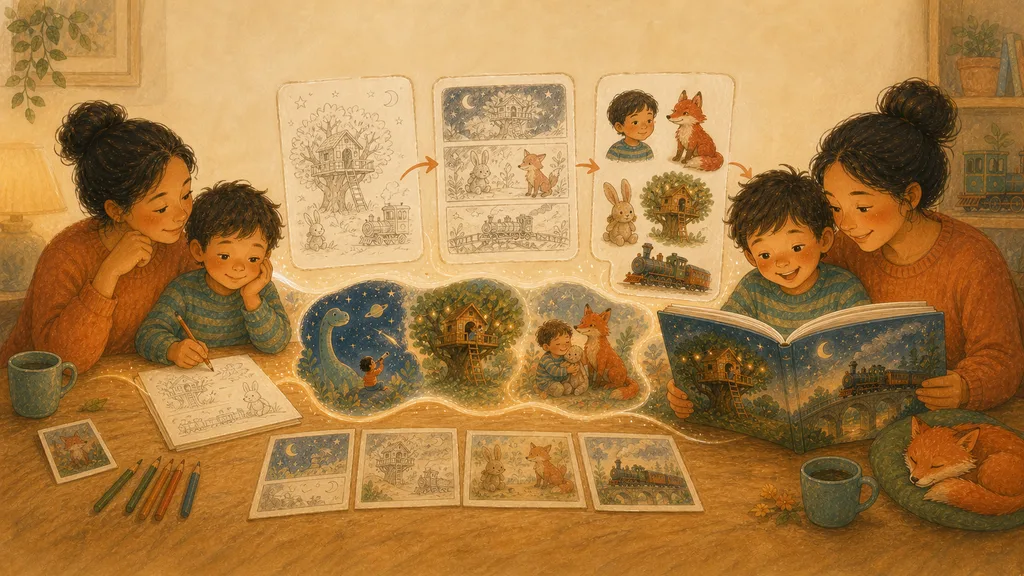
You do not need to imagine an entire book before you begin. Set a direction with one honest description, then confirm the outline, prose, illustrations, and preview one stage at a time.
Your first story does not need to begin with a complete plot
“I want a story about a treehouse.” “My child is afraid to sleep alone.” “She loves whales.” Each is already a valid starting point.
Parents often feel they have too little information, or try to decide every character, chapter, ending, and picture before beginning. Neither is necessary. Parents bring observations and hopes; the creative process turns those clues into structure, scenes, and images. A truthful beginning followed by gradual decisions is more dependable than an imaginary perfect plan.
Step 1: Set the direction in one paragraph
You do not need a professional prompt. Describe:
- the child's approximate age and understanding;
- one specific current interest;
- a change or emotion they are experiencing;
- the feeling you hope the story leaves;
- the reading situation and anything to avoid.
For example:
My daughter An-An is six. She draws treehouses every day and loves caring for small animals. She has just joined a new class and rarely starts conversations. I would like a warm, imaginative bedtime story in which a character gradually learns to cooperate. Please avoid direct lessons, getting lost, and strong scares.
There is no plot yet, but the paragraph already tells us who the story is for, where to enter, and what it should leave behind. Clear direction matters more than abundant detail.
Step 2: Confirm the outline before writing the prose
An outline tests the story's skeleton, not every sentence. Check what the character wants, what prevents it, and whether change follows naturally.
A useful outline includes:
- The character and starting situation;
- A concrete wish or task;
- The event that begins the story;
- Two to four attempts, obstacles, or discoveries;
- A decisive choice;
- An outcome that answers the opening.
Suppose a fox builds a treehouse alone and other animals suddenly arrive to help. The ending is pleasant, but the relationship has not been earned. A parent might ask the fox to discover it cannot lift a plank, then seek advice from a squirrel skilled at knots. Cooperation begins with one small shared task.
Ask whether the problem is understandable, the character causes change through a choice, the emotional intensity fits the child, and the ending feels safe without closing every possibility. Do not generate the full text until the outline feels right. Changing the skeleton is cheaper than rewriting the book.
Step 3: Turn “what happens” into “how it is experienced”
Prose adds setting, action, dialogue, rhythm, and emotional movement. It should give important moments room rather than expanding every outline point equally.
Does the language fit the age?
Young children benefit from visible actions, concrete images, and measured repetition. Older children can follow more cause and effect, inner thought, and indirect meaning. Unfamiliar words are fine when context supports them.
Can the plot be seen?
“The fox learned to cooperate” is a summary. Show the plank stopping halfway, the knot slipping repeatedly, and the fox finally asking, “Will you teach me that knot?” Growth should occur through action and choice.
Does each passage move the story?
Too much description stops momentum. Familiar detail creates connection; events carry the reader forward. Read the draft aloud, remove repeated explanations, and slow down rushed turns. Clarity and speakable rhythm matter more than ornate writing.
Step 4: Fix the character and visual rules before illustrating
Illustration selects moments worth seeing; it does not literally reproduce every sentence. Before the first image, define:
- species, apparent age, build, and main colors;
- clothing, belongings, and recognizable features;
- medium, palette, and lighting for the whole book;
- unwanted elements;
- space needed for text.
Give pages different jobs: establish the setting, reveal the obstacle, show a decision, enlarge an emotion, or resolve the story. Avoid a sequence of centered smiling portraits.
Test one key scene first. If the fox, treehouse, and visual style work, continue. When later images change clothing, proportions, or color, return to the same character description rather than reinventing it page by page.
Step 5: Use continuous preview to see whether it feels like a book
Good individual paragraphs and pictures do not guarantee a good sequence. Read and preview from beginning to end. Check:
- whether the opening enters the story quickly;
- whether neighboring pages repeat information;
- whether text length changes abruptly;
- whether each image matches its scene;
- whether characters and places remain consistent;
- whether page turns create anticipation;
- whether the ending fits the reading moment.
Read aloud to expose long sentences, stiff dialogue, and broken rhythm. If the book will be printed, also check resolution, aspect ratio, safe margins, and possible trimming. Preview is where text and pictures finally become one book.
Three common first-book mistakes
Trying to solve everything at once
Friendship, tidiness, courage, sharing, and sleep cannot all be the central task. Choose one change; let other values remain in the background.
Expecting every stage to work on the first attempt
Outlines, prose, and pictures are designed to be revised. Iteration prevents effort from accumulating in the wrong direction.
Checking only whether it resembles the child
Names and interests create familiarity, but a story still needs desire, obstacle, choice, and result. Personal details should serve the plot, not replace it.
A practical order for the first creation
- Write down the child, interest, experience, desired feeling, and boundaries;
- Generate and discuss only the outline;
- Revise and confirm it;
- Generate the prose, read it aloud, and adjust;
- Fix character and style, then test one key illustration;
- Create the remaining images and check consistency;
- Preview the whole book before exporting or printing.
At each stage, answer one main question. The goal of a first personalized story is not instant perfection, but a method you will want to use again.