How Do You Keep Character Details and Plot Consistent?
 Elara Finch 8 min read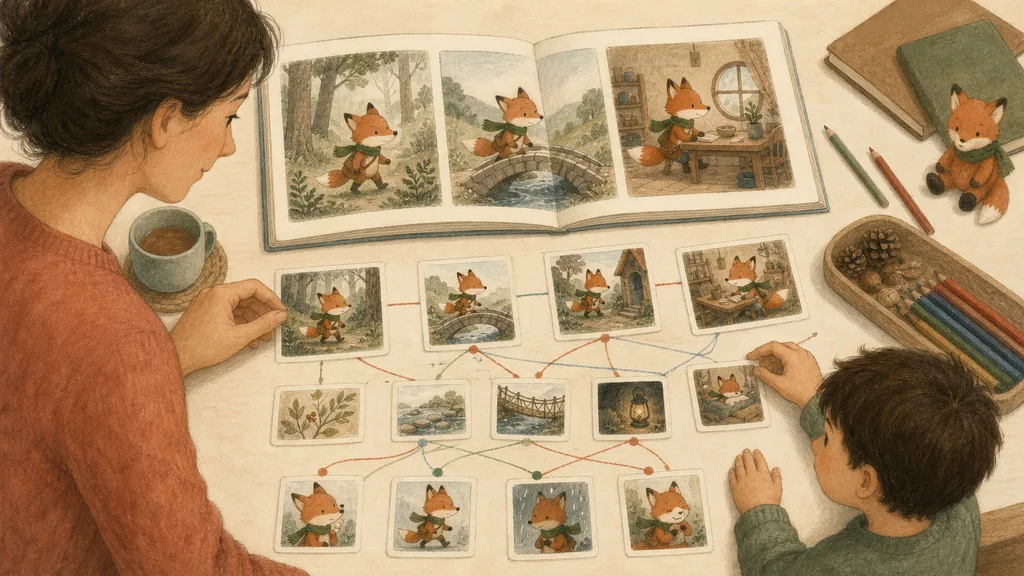
Consistency means more than remembering the color of a coat. Character, ability, objects, clues, and consequences must continue across every revision. A small story fact sheet prevents many contradictions.
Consistency makes one story world believable
A character fears water in chapter one but dives into a lake without explanation in chapter three. A key given to an owl returns to the hero's pocket. A journey begins at dusk but the sky stays bright through many events. Each contradiction pulls attention out of the story.
Children may not name the error, yet they often remember colors, objects, and repeated rules. Consistency does not restrict imagination. It gives change a reason and makes an imagined world worth believing.
Longer stories and repeated revisions exceed memory. Save confirmed facts so every new passage can begin from the same foundation.
Build a concise character sheet
Record only stable information that affects the story:
- name, species, or identity;
- apparent age, build, colors, and recognizable features;
- clothing and carried objects;
- strongest desire and concern;
- existing abilities and clear limits;
- speaking style and repeated gestures;
- relationships with other characters.
Do not collect dozens of irrelevant facts. “Loves blueberries” need not be fixed unless it affects plot or illustration.
For example: Lolo is a young fox with a dark green scarf and an old compass. He reads tracks well but cannot swim, listens before speaking to strangers, and wants to find the migrating geese before winter. Appearance, ability, behavior, and goal are all usable.
Characters can grow, but events must support the change. If Lolo learns to swim, show practice, assistance, or a condition before he suddenly crosses a river.
Save facts and rules about the world
Keep four kinds of facts:
- Place: Which side of the river holds the treehouse, and how are locations connected?
- Time: What season and time of day is it, and how much time passes?
- Objects: Who holds each object, and has it been damaged, used, or transferred?
- Rules: What activates magic, can animals speak, and why does a door open only once?
Once introduced, a rule must hold or the exception needs an explanation. If a moon key works only under a full moon, it cannot casually open the door on a cloudy afternoon. An exception can be prepared earlier, such as the key also responding to an honest promise.
The text need not explain every rule, but the creator must know them.
Check the plot with a chain of cause and effect
Compress each scene into “because—therefore”:
Because rain destroyed the bridge, Lolo takes the mountain path. Because that path crosses the dark pines, he brings a glowing mushroom. Because its light attracts moths, he notices a hidden sign.
If adjacent scenes cannot connect through causation or choice, the plot may be only a pile of events. Watch for:
- coincidence immediately solving a problem;
- a character knowing information never received;
- an emphasized object never being used;
- a final solution relying on a new ability;
- a key decision unrelated to the character's earlier desire.
Repairing causation is easiest in the outline. After drafting, verify that each turn was prepared and each promise answered.
Trace the effects of every revision
Changing a rabbit into a beaver is not a name replacement. Swimming ability, home, movement, illustrations, and other characters' descriptions may all change.
Classify the revision:
- Surface: name, color, or one line of dialogue;
- Setting: identity, ability, relationship, or world rule;
- Structure: goal, conflict, scene order, or ending.
After a setting or structural change, inspect the outline, prose, character sheet, object state, image prompts, and completed illustrations. Do not change only the sentence where the problem appeared; change every echo it leaves in the story.
Keep personality consistent through choices
Consistency does not mean repeating one action forever. A cautious character can take a risk when the reason is strong enough; a talkative character can become silent if the reader sees why.
For each important choice, ask:
- What does the character know now?
- What do they most want to protect or obtain?
- Which choice fits their established behavior?
- If they choose differently, what caused the change?
Growth should feel like an old method becoming insufficient and a new one being tried, not a person suddenly being replaced.
Illustrations must inherit the same facts
Save body shape, color, clothing, accessories, relative height, and immutable features. Each image prompt should inherit that base and add the current action, expression, place, and light.
Track object states too. A scarf torn on page two cannot be perfect on page five. A compass handed to a friend should not remain on Lolo's belt.
Before each image, ask: who is here, where are they, what do they currently possess, and what just happened?
Run a continuity review before publishing
Read several times, focusing on one category per pass:
- Character: name, appearance, ability, motive, relationship;
- Time and place: daylight, season, distance, movement;
- Objects and clues: introduction, transfer, damage, use, payoff;
- Causation: reason and result of each turn;
- Text and image: whether the picture matches the current state.
Lay scene cards side by side to see when information appears and returns. Stable facts, clear causation, and motivated growth form continuity—and make every surprise more powerful.