How Do You Keep Characters and Art Style Consistent Across Every Illustration?
 Elara Finch 8 min read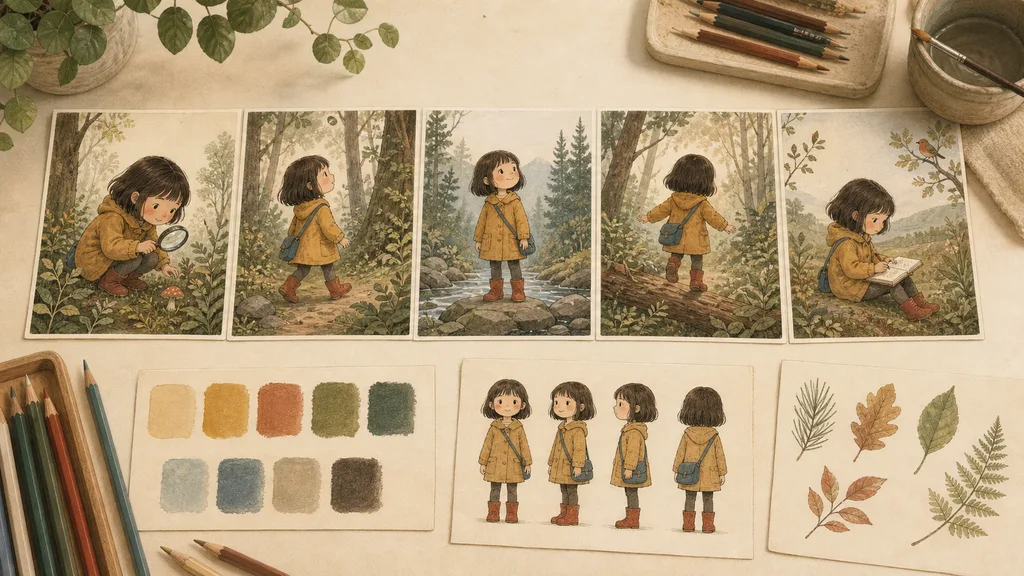
Define characters, style, and scene rules first. Reuse that visual foundation on every page and track story changes to reduce face, clothing, and style drift.
Consistent illustrations need a visual system
A character begins with a round face and short hair, grows long hair on page three, then changes clothes and apparent age. The forest shifts from soft watercolor to bright animation. Individual images may be attractive, yet they do not feel like one book.
An image model redraws from the information it receives each time. “A girl in a forest” does not preserve a previous design. Consistency comes from visual facts inherited by every page, not from repeating one vague prompt.
Create a character reference first
Record the features that should not drift:
- apparent age, build, and proportions;
- face, hair, skin, or fur;
- fixed clothing, shoes, and accessories;
- two or three recognizable details;
- relative height beside other characters;
- changes that are not allowed.
Example: “A six-year-old girl with a round face and dark-brown bob, mustard coat, red rain boots, and blue canvas satchel; leaf patch on the left side; same outfit and proportions in every scene.”
Use specific shades and materials, but avoid excessive ornaments. Generate and approve a reference with front, side, and common expressions before making the pages.
Describe the style of the whole book
“Cute” and “fairy-tale” are too broad. Define:
- Medium: watercolor, pencil, collage, crayon, or clay;
- Line: delicate, loose, borderless, or inked;
- Color: muted warm palette, cool clarity, or limited colors;
- Light: soft morning, golden evening, or even interior light;
- Composition: generous space, wide cinematic view, or eye-level picture book;
- Exclusions: no text, watermark, plastic gloss, or photographic realism.
A full sentence such as “delicate watercolor and pencil on cream paper, sage, terracotta, and dusty blue, with soft golden light” is more dependable than “watercolor style.”
Separate fixed and changing prompt layers
Use the same structure for every image:
- Fixed character: the approved reference facts;
- Fixed style: the book-wide visual description;
- Current scene: place, time, weather, required objects;
- Current action: who does what and feels what;
- Composition: shot, viewpoint, position, and space for text;
- Continuity state: wet clothing, transferred objects, changing daylight.
Do not paste the entire prose. Describe one drawable instant: “The girl crouches beside the stream, lifts her satchel overhead, and reaches for the paper boat.”
Test a key page before generating the book
Choose a page containing the hero, main environment, and typical light. Check age, personality, reproducible clothing, palette, text space, and whether the style can support both quiet and active scenes.
Then test two contrasting pages, such as an indoor close-up and an outdoor wide shot. If all three remain stable, continue. One early correction is cheaper than remaking eight pages.
Track story changes page by page
Consistency does not mean nothing changes. Muddy boots, a torn scarf, and sunset are meaningful—but each change must continue.
Save a state line per page:
Page 4: mustard coat and red boots; sleeves wet; girl carries blue satchel; after-rain evening; leaf patch intact.
The next page inherits this state. Track transfers, damage, clothing changes, and recovery. Repeated locations also need a small reference for doors, windows, bridges, and furniture.
Correct one variable at a time
If the face drifts, do not also replace composition, light, and style. Strengthen face and proportions while preserving the rest.
- Face or age drift: simplify adjectives and reinforce the reference;
- Clothing color: repeat exact shade, material, and fixed requirement;
- Style drift: reuse medium, line, palette, and light;
- Wrong cast: state exactly who is present;
- Repeated composition: vary shot and action, not the visual rules;
- Gibberish text: request no text and typeset later.
A regenerated page still needs the full fixed layers, not only “make the coat yellow.”
Review the whole book visually
Place all thumbnails together, then inspect details. Check characters, object states, time and weather, repeated locations, palette, variety of shots, and image-to-text accuracy.
Remake the images that most damage continuity before polishing minor differences. True consistency does not make every picture identical; it makes us believe the same characters continue through the same world.